 Skip to content
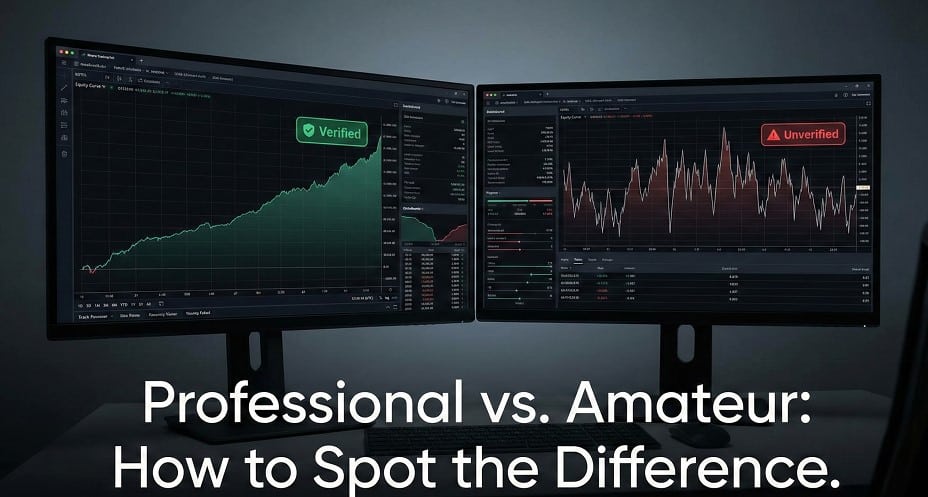

The Forex market is flooded with self-proclaimed “gurus” posting screenshots of massive profits. Yet, most retail traders who follow them end up losing their capital.
The problem isn’t that profitable traders don’t exist. The problem is that the industry is filled with smoke and mirrors—demo accounts disguised as real ones, photoshopped results, and high-risk strategies that eventually blow up. You need a way to filter the noise.
Finding a professional forex trader isn’t about chasing the highest monthly return. It is about identifying risk management, consistency, and verified data. This guide will teach you how to audit a trader like a professional fund manager before you invest a single dollar.
The Anatomy of a Professional Trader (vs. The Gambler)
What separates a professional from a lucky amateur? It comes down to one word: Longevity.
A gambler might flip $1,000 into $10,000 in a month using high leverage. But they will almost certainly lose it all the next month. A professional trader focuses on Capital Preservation first. Their goal is not to double the account overnight, but to generate steady, compounding returns over years.
Why “Boring” is Better
Real professional trading often looks boring. A legitimate professional targets sustainable growth—typically 3% to 10% per month.
If you see a trader promising 50% or 100% monthly returns, run. These returns usually require risking the entire account on a few trades. That is not trading; that is betting.
The “Real” Account Non-Negotiable
Never trust a track record based on a Demo account.
- Psychology: Trading play money carries zero emotional weight.
- Execution: Demo accounts often have perfect execution speeds that don’t exist in the live market (no slippage).
Always insist on seeing a Live or Real account. If a trader isn’t willing to risk their own money on their strategy, you shouldn’t risk yours either.

The “Forensic Audit”: How to Verify a Track Record
Don’t trust screenshots. Screenshots can be edited in seconds. To find a professional forex trader, you must demand a Third-Party Audited Track Record.
Platforms like Myfxbook, MQL5, or SignalStart connect directly to the trader’s broker server. They pull the trading history automatically, making it nearly impossible to fake the data.
4 Steps to Vet a Trader (The Checklist)
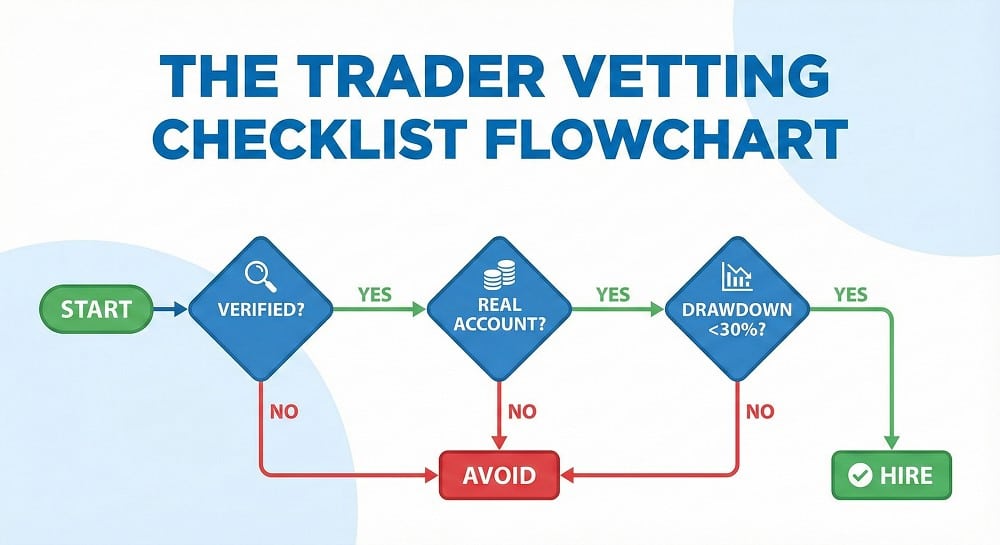
Use this process to filter out 99% of scams:
- Check for the Link: Ask for a clickable link to their Myfxbook or MQL5 system. If they refuse, stop here.
- Verify Account Status: Look for the tag “Real” (not “Demo”) and the broker name.
- Check Verification Badges: On Myfxbook, ensure you see two green checkmarks: “Track Record Verified” and “Trading Privileges Verified.” This proves they own the account.
- Analyze the Equity Curve: A healthy curve goes up gradually from left to right. Avoid curves that look like a jagged staircase (indicating a “Martingale” strategy where they double down on losing trades).
Key Metrics You Must Analyze Before Investing
Once you have verified the account is real, look at the math. Three specific metrics reveal the trader’s true skill level.
Maximum Drawdown (DD)
This is the most critical number. It measures the biggest drop the account suffered from a peak to a trough.
- High Risk: > 40% Drawdown.
- Professional Standard: < 20-30% Drawdown.
If a trader has a 90% drawdown, they nearly lost the entire account at one point. That is unsafe for any serious investor.
Account Age
Everyone can be lucky for three months. Very few can be profitable for three years.
Look for a history of at least 12 to 24 months. A long track record proves the strategy can survive different market conditions—like news spikes, wars, or economic crashes.
Note: My own trading history spans over 10 years, with verified data available for deep analysis. You can view these metrics directly on the Sarowar Jahan Investor Access page.
Service Models: Copy Trading vs. Fund Management
Once you find a trader, how do you work with them? There are two main models.
Copy Trading (Signal Service)
You link your personal brokerage account to the trader’s master account. When they open a trade, it is automatically copied to your account.
- Pros: You keep funds in your own name; you can disconnect anytime.
- Best for: Investors who want control.
Fund Management (PAMM/MAM)
You deposit funds into a pooled account managed by the trader. The profits are distributed automatically based on your share.
- Pros: Totally hands-off; often better execution for large capital.
- Best for: Serious investors with higher capital ($10k+).
Comparison: Which is Right for You?
| Feature | Copy Trading / Signals | Fund Management (PAMM) |
| Control of Funds | 100% in your own account | Pooled in a master account |
| Setup Difficulty | Medium (Requires VPS/Software) | Low (Deposit and forget) |
| Fees | Usually Monthly Subscription | Performance Fee (Profit Share) |
| Capital Requirement | Low ($500+) | Higher ($2,000+) |
| Transparency | High (See every trade live) | Medium (See daily/monthly reports) |
Why Choose Sarowar Jahan?
If you are looking for a transparent, verified, and experienced partner in your trading journey, I invite you to review my portfolio.
I am Sarowar Jahan, a professional Forex trader and fund manager. Unlike anonymous signal providers, I operate with full transparency:
- 10+ Years of Experience: Navigating the markets since 2015.
- Fully Verified: My accounts are audited by Myfxbook and MQL5.
- Risk-First Approach: I prioritize protecting your capital with strict drawdown limits.
Whether you need reliable Signal Services for your own account or personalized Fund Management, I offer solutions backed by data, not empty promises.
Frequently Asked Questions (FAQ)
How do I verify if a forex trader is legitimate?
Review their third-party audited track record on Myfxbook or MQL5.
Ensure the account is listed as “Real” (not Demo), has “Verified” badges, and shows a history of at least 12 months. Avoid traders who only show screenshots of profits without a live link.
What is a good monthly return for a professional forex trader?
A sustainable target is typically 3% to 10% per month.
Returns consistently higher than 20% often indicate high-risk strategies that inevitably lead to blown accounts. Professional trading prioritizes consistency and compounding over “get-rich-quick” spikes.
What is the difference between copy trading and fund management?
Copy trading mirrors trades to your personal account; fund management pools capital.
In copy trading, you retain full control of your broker account and pay a subscription. In fund management (PAMM), you invest in a managed pool, and the trader takes a share of the profits (performance fee).
Why is drawdown important when choosing a forex trader?
Drawdown measures the risk of losing your capital.
It shows the largest percentage drop the account has ever experienced. A professional trader keeps drawdown low (under 30%) to ensure that recovery is mathematically possible and your investment remains safe.
Ready to Invest with Confidence?
Don’t gamble with your hard-earned money. Choose a strategy backed by a decade of experience and verified results.
Visit SarowarJahan.com to view my live performance and start copying today.
