

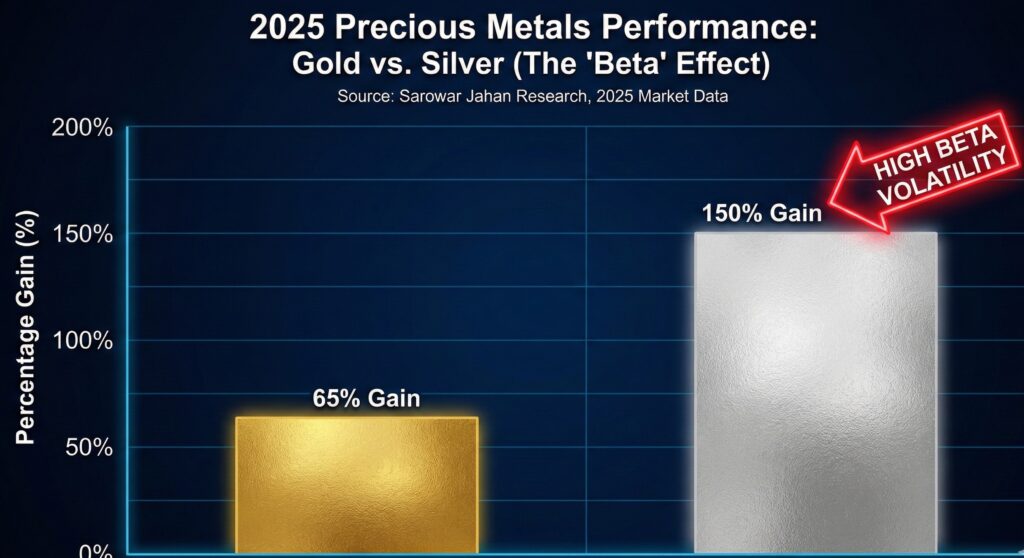
If you held cash in 2025, you lost purchasing power. If you held bonds, you treaded water. But if you held precious metals, you witnessed a historic decoupling of real assets from the traditional financial system.
By the time the closing bell rang on December 31, 2025, gold had rallied nearly 65%, while silver exploded higher with a 150% gain. This wasn’t just a “safe haven” trade; it was a structural repricing of global liquidity.
For investors navigating 2026, the question is no longer “Why did it happen?” but “What happens next?” At Sarowar Jahan, we analyze these macro-shifts to help you separate temporary noise from generational trends.
Below is the breakdown of the 2025 “Melt-Up” and the specific signals including the critical $5,400 price target that you need to watch in 2026.
The “Melt-Up” Explained: Why 2025 Was Different
To the untrained eye, the 2025 rally looked like panic buying. It wasn’t. It was the result of three specific macro-economic forces converging at once: Real Yield Compression, De-dollarization, and Sovereign Debt Anxiety.
Unlike previous cycles where gold rose only when the dollar fell, 2025 saw gold rise alongside the dollar and alongside interest rates. This broke the traditional correlation models used by Wall Street algorithms.
Why? Central Banks stopped trusting Treasuries.
In 2025, net purchases of US Treasuries by foreign central banks hit multi-decade lows, while gold accumulation hit record highs. The market realized that with US debt-to-GDP ratios spiraling, the only “risk-free” asset left was the one with no counterparty risk: Gold.
The “Silver Squeeze”: Industrial Demand vs. The Deficit
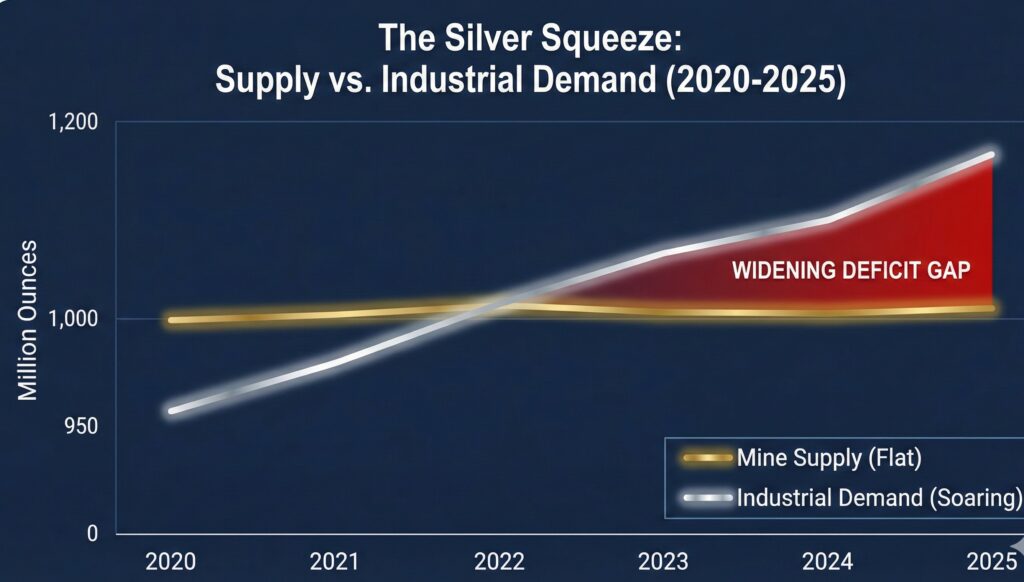
While gold marched higher on monetary trends, silver’s 150% explosion was driven by something entirely different: Physics.
Silver is no longer just a monetary metal; it is a critical technology metal. In 2025, we entered the fifth consecutive year of a structural supply deficit. The world consumed far more silver than miners could pull from the ground.
The Solar & AI Factor
Two industries drained global silver stockpiles in 2025:
- TOPCon Solar Panels: The shift to “Tunnel Oxide Passivated Contact” solar cells requires 30-50% more silver paste than previous generations. As China and the EU raced to meet 2030 green energy targets, industrial demand skyrocketed.
- AI Hardware: The massive data centers powering Artificial Intelligence require high-performance connectors and switches. Silver, being the most conductive metal on earth, became non-negotiable for these high-speed processors.
This created a “Silver Squeeze” where industrial users (like Samsung and Tesla) were bidding directly against investors for physical bars.
Gold in 2026: The $5,400 Institutional Target
As we enter Q1 2026, the floor for gold has moved. The “buy the dip” crowd is no longer just retail investors; it is massive private institutions.
Goldman Sachs recently raised their year-end 2026 forecast to $5,400 per ounce. This bullish revision is based on the entry of “Private Wealth” into the market. Family offices and high-net-worth individuals are now allocating 2-5% of their portfolios to physical gold to hedge against “debasement” the fear that fiat currencies will continue to lose value regardless of what the Federal Reserve does.
Who is Buying? (The Shift to Private Wealth)
In previous years, Central Banks were the whales. In 2026, the baton has passed to private capital. With the S&P 500 trading at historically high valuations, smart money is rotating profits into hard assets to lock in gains.
| Feature | Gold’s Role (Monetary) | Silver’s Role (Industrial) |
| Primary Driver | Central Bank Buying & Wealth Preservation | Solar (PV), AI, & EVs |
| 2025 Performance | ~65% Gain (Steady) | ~150% Gain (Volatile) |
| Recession Risk | Performs well (Safe Haven) | Risk of correction (Industrial slowdown) |
| 2026 Target | $5,400/oz | $100 – $120/oz |
The Golden Signal: Watch the Gold-to-Silver Ratio
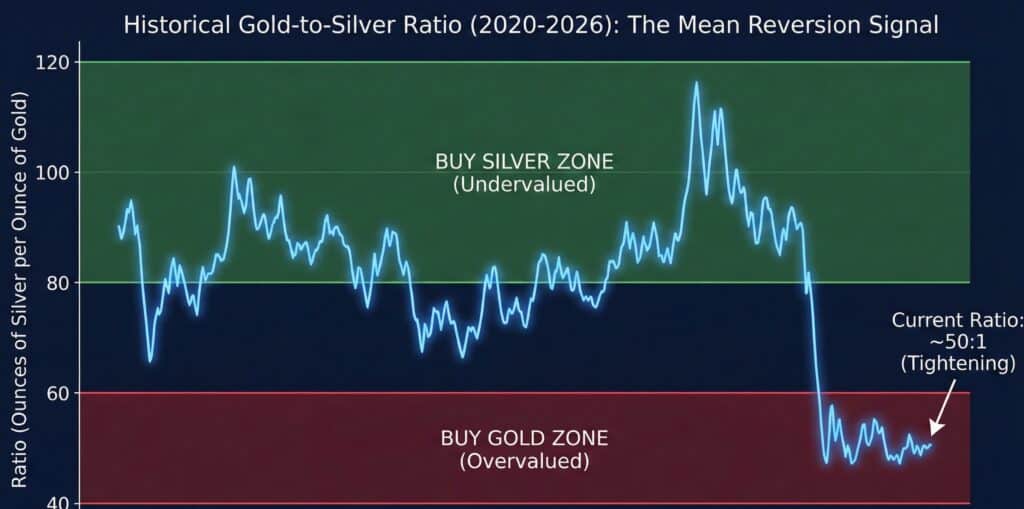
If you take only one thing from this article, let it be this metric. The Gold-to-Silver Ratio measures how many ounces of silver it takes to buy one ounce of gold.
- Historical Average: 60:1
- 2024 High: >100:1 (Silver was cheap)
- January 2026 Status: ~50:1 (Silver is catching up)
The “Mean Reversion” Play
We are currently seeing a massive compression of this ratio. At 50:1, silver is becoming expensive relative to its history.
This signals a potential pivot point for traders. If the ratio drops below 40:1, it often indicates that silver is “overbought” and due for a correction. Conversely, if gold runs to $5,400 and silver lags, the ratio could widen again, offering a new buying opportunity.
2026 Investment Outlook: Threats and Opportunities
The trend is your friend, but volatility is the enemy. While the long-term thesis remains bullish, 2026 will likely bring sharp corrections.
Actionable Strategy for Investors
- Don’t Chase Spikes: With silver up 150%, FOMO (Fear Of Missing Out) is dangerous. Wait for pullbacks to the 200-day moving average.
- Watch the Fed: If the Federal Reserve cuts rates aggressively in 2026 to save the housing market, gold will likely gap higher.
- Diversify Storage: If you hold physical metal, ensure it is stored in a non-bank jurisdiction to avoid counterparty risk.
For more deep dives into market trends, forex strategies, and asset protection, keep following our updates at Sarowar Jahan.
Frequently Asked Questions (FAQ)
Why did silver outperform gold in 2025?
Silver benefited from a dual-driver effect: extreme industrial demand (Solar/AI) and a speculative “catch-up” trade. Because the silver market is smaller than gold’s, huge capital inflows caused explosive price volatility, resulting in roughly double the percentage gains of gold.
Will gold prices go down in 2026?
A major crash is unlikely. While short-term profit-taking is expected after such a massive rally, the structural drivers—central bank buying and falling real interest rates—remain intact. Major support levels are forming around $4,500.
Is it a good time to buy silver in 2026?
Yes, but caution is required. The long-term case is strong due to the 6th year of supply deficit. However, with the Gold-to-Silver ratio near 50:1, silver is historically “expensive” relative to gold, suggesting volatility ahead.
What is the gold price prediction for 2026?
Institutions are targeting $5,400. Analysts at firms like Goldman Sachs see gold averaging between $4,800 and $5,400 by year-end, driven by private wealth diversification and persistent geopolitical instability.
How does the “Gold-to-Silver Ratio” affect trading in 2026?
It acts as a timing signal. A ratio below 40:1 typically suggests silver is overvalued and traders might swap into gold. A ratio above 80:1 suggests silver is undervalued. Currently, at ~50:1, the markets are tightening.
Connect on Telegram Don’t miss out on critical market updates. Join my Telegram community for the latest news and trading signals delivered straight to your phone: https://t.me/mql5signals_Sarowar