


You’ve likely seen the pitch: a trading system with a 100% win rate. It sounds impossible, yet the math seems to check out. Just double your trade after every loss, and eventually, one win will recover everything.
It sounds like the “Holy Grail” of trading.
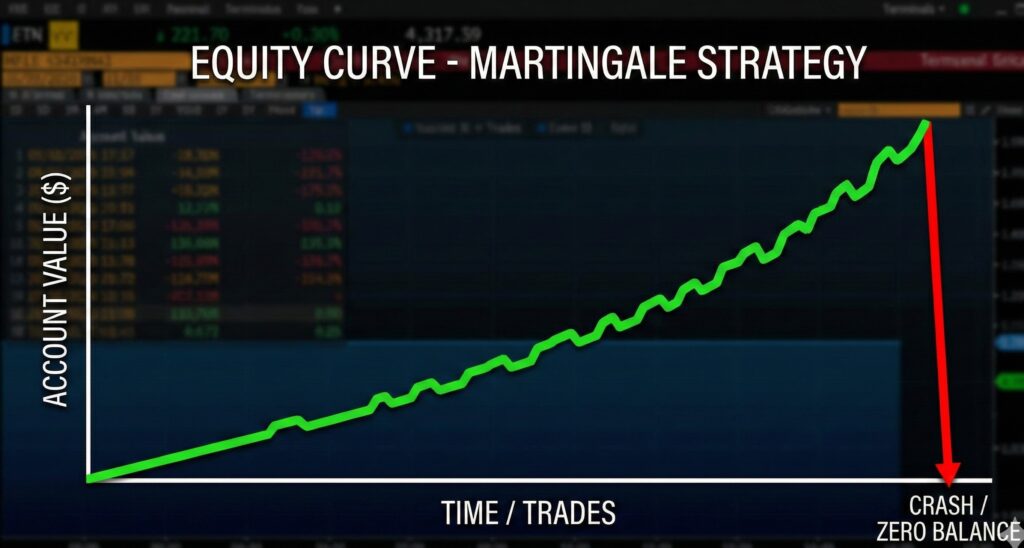
But here is the reality most gurus won’t tell you: The Martingale strategy works perfectly until the moment it wipes out your entire account in a single afternoon.
This guide breaks down the mechanics, the deceptive math, and the critical risks of the Martingale system. At Sarowar Jahan, we believe in informed trading, so let’s look at the numbers before you risk your capital.
What Is the Martingale Strategy?
The Martingale strategy is a negative progression system that originated in 18th-century France. While it started in gambling halls, it has found a permanent home in Forex and crypto trading.
The core concept is simple: You double your position size after every loss.
The theory relies on the concept of “Mean Reversion.” It assumes that price cannot move in one direction forever. Eventually, the market must turn back. When it does, your doubled trade size ensures you recover all previous losses and secure a profit equal to your initial stake.
Key Characteristics:
- Loss Recovery: It prioritizes recovering losses over maximizing gains.
- Zero-Sum Game: It assumes a win is statistically inevitable.
- Negative Progression: You increase risk when you are losing, contrary to standard risk management advice.
How It Works: The Math Behind the Madness
To understand why this strategy is so seductive, you have to look at the progression.
The Coin Flip Analogy
Imagine betting $10 on a coin toss.
- Toss 1: You bet $10. You lose. (Total Loss: -$10)
- Toss 2: You bet $20. You lose. (Total Loss: -$30)
- Toss 3: You bet $40. You win $40.
The Result: You win $40, which covers the $30 loss from the first two tosses and leaves you with a $10 profit.
Real-World Forex Example
In Forex, this involves doubling your Lot Size. Let’s say you are trading EUR/USD with a target of 20 pips.
| Trade # | Lot Size | Result | P/L ($) | Cumulative P/L |
| 1 | 0.10 | Loss | -$20 | -$20 |
| 2 | 0.20 | Loss | -$40 | -$60 |
| 3 | 0.40 | Loss | -$80 | -$140 |
| 4 | 0.80 | Loss | -$160 | -$300 |
| 5 | 1.60 | Win | +$320 | +$20 |
Notice trade #5. You risked 1.60 lots just to make a net profit of $20. This is the Martingale paradox: Risk increases exponentially, while potential profit remains linear.
The Hidden Dangers: Why Martingale Fails
If the math works, why isn’t everyone rich?
The strategy relies on a flawed assumption: Infinite Capital.
In theory, if you have infinite money to keep doubling, you cannot lose. In reality, you have a limited account balance and a broker who will issue a margin call.
1. The Risk of Ruin
The doubling effect is deceptive. It starts small (1, 2, 4…) but explodes quickly. By your 10th loss, you are betting 512 times your initial size.
A string of 10 losses might seem rare, but in Forex, strong trends occur frequently. If you are shorting a currency pair that rockets upward for days, your account will vanish before the market reverses.
2. Broker & Market Limits
Even if you have deep pockets, you will hit a wall:
- Maximum Lot Size: Most brokers cap the max lot size (e.g., 50 or 100 lots). Once you hit this cap, you can no longer double down to recover.
- Leverage Constraints: As your trade size grows, your used margin skyrockets. You will likely hit a Margin Call long before your balance hits zero.
Practical Application: Can It Work in Forex?
Despite the risks, Martingale remains popular in the algorithmic trading community.
Where It “Works”
Martingale is most effective in Range-Bound Markets.
When a currency pair is moving sideways (choppy), prices revert to the mean frequently. In this environment, a Martingale Expert Advisor (EA) can rack up small wins all day long.
However, the moment a “Black Swan” event occurs or a central bank announces a rate change, the pair will trend hard. That single trend is what wipes out months of Martingale profits.
The “Soft” Martingale
To mitigate risk, smart traders modify the multiplier. Instead of doubling (2.0x), they use a 1.5x multiplier.
- Standard: 1.0, 2.0, 4.0, 8.0…
- Soft: 1.0, 1.5, 2.25, 3.37…
This delays the risk of ruin, giving the market more time to reverse, though it also requires a bigger win to recover the losses.
Martingale vs. Anti-Martingale
If Martingale is “doubling down on losses,” what is the opposite?
Anti-Martingale involves increasing your trade size only after a win.
- Martingale: High risk, high win rate, sensitive to losing streaks.
- Anti-Martingale: Lower risk, capitalizes on winning streaks (“letting profits run”).
For most traders visiting Sarowar Jahan, we recommend focusing on strategies that preserve capital like Anti-Martingale or fixed fractional position sizing rather than risking it all on a reversal that may never come.
Frequently Asked Questions (FAQ)
What is the Martingale strategy in simple terms?
It is a system where you double your bet after every loss.
The goal is to recover all previous losses with a single win. It transforms trading into a game of “chicken” with your account balance.
Does the Martingale strategy work in Forex?
Yes, but usually only in the short term.
It works well in sideways, ranging markets. However, it fails catastrophically in trending markets. It is not a question of if you will blow your account, but when.
Is Martingale trading illegal?
No, it is not illegal.
However, casinos often ban it, and some Forex prop firms or brokers may restrict high-volume Martingale bots because of the massive leverage required during a losing streak.
What is the biggest risk of the Martingale system?
The “Risk of Ruin” (total account loss).
Because trade sizes grow exponentially, a relatively standard losing streak of 8-10 trades can require a position size larger than your entire account balance.
What is the difference between Martingale and Anti-Martingale?
Martingale increases risk after a loss; Anti-Martingale increases risk after a win.
Martingale tries to recover losses (defensive). Anti-Martingale tries to maximize winning streaks (offensive).
Final Verdict
The Martingale strategy is a mathematical curiosity, not a sustainable business plan. While the allure of “always recovering” is strong, the price you pay is the constant risk of total ruin.
Smart trading is about risk management, not chasing losses. For more insights on building a sustainable trading career and safer algorithmic strategies, keep exploring Sarowar Jahan.
Connect on Telegram Don’t miss out on critical market updates. Join my Telegram community for the latest news and trading signals delivered straight to your phone: https://t.me/mql5signals_Sarowar