
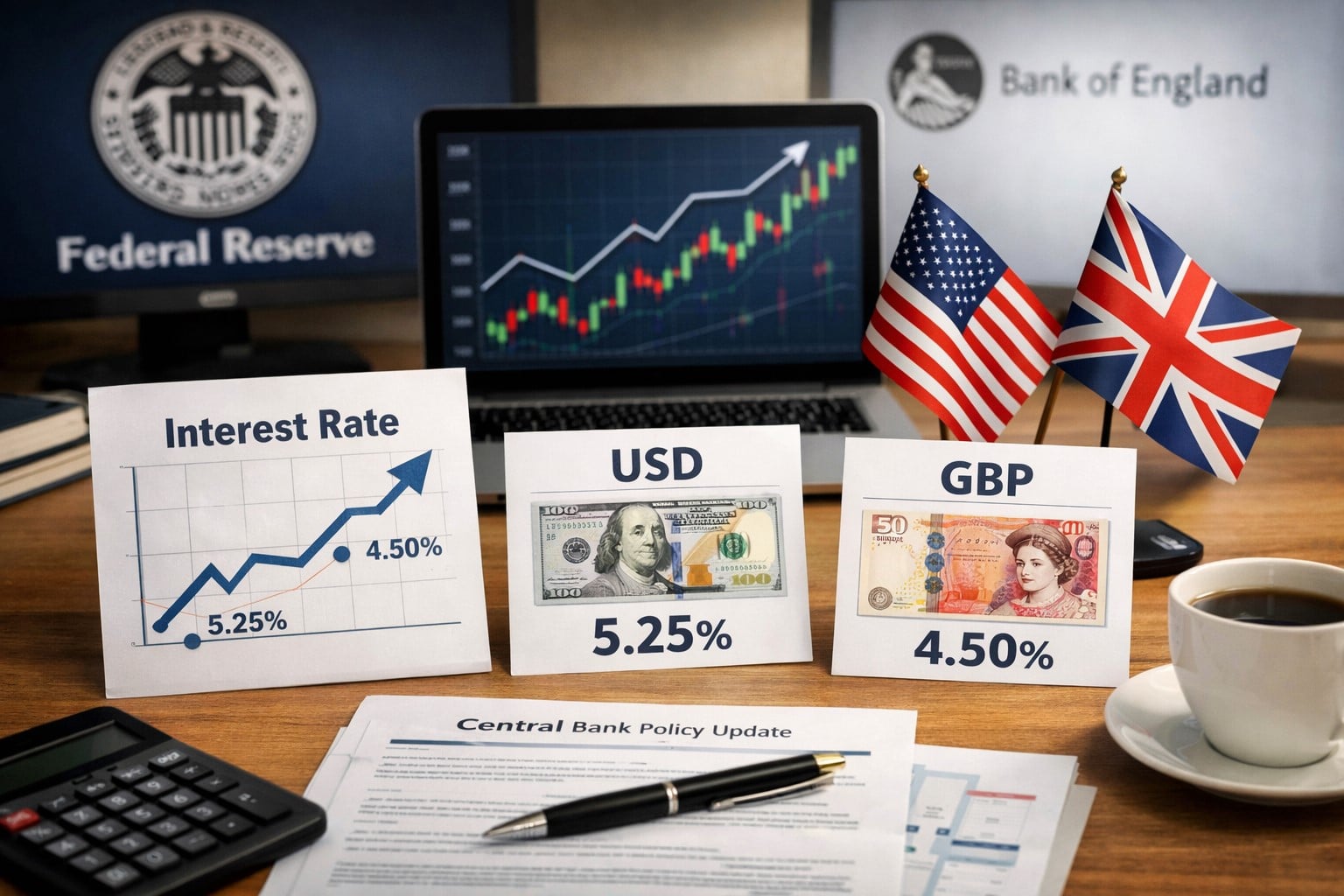

Professional trading often comes down to one question: What is the cost of money? If you can answer that, you can predict capital flow.
Traders often feel like they are chasing shadows when central banks speak. You see a “hawkish” headline, watch the GBPUSD spike, and then see it reverse within minutes. This volatility isn’t random; it’s the result of yield differentials shifting in real-time.
At https://sarowarjahan.com, we focus on the mechanics behind the candles. By understanding how interest rates act as a magnet for global capital, you can stop guessing and start positioning based on macroeconomic reality.
The Mechanics: Why Interest Rates are the “Price” of Money
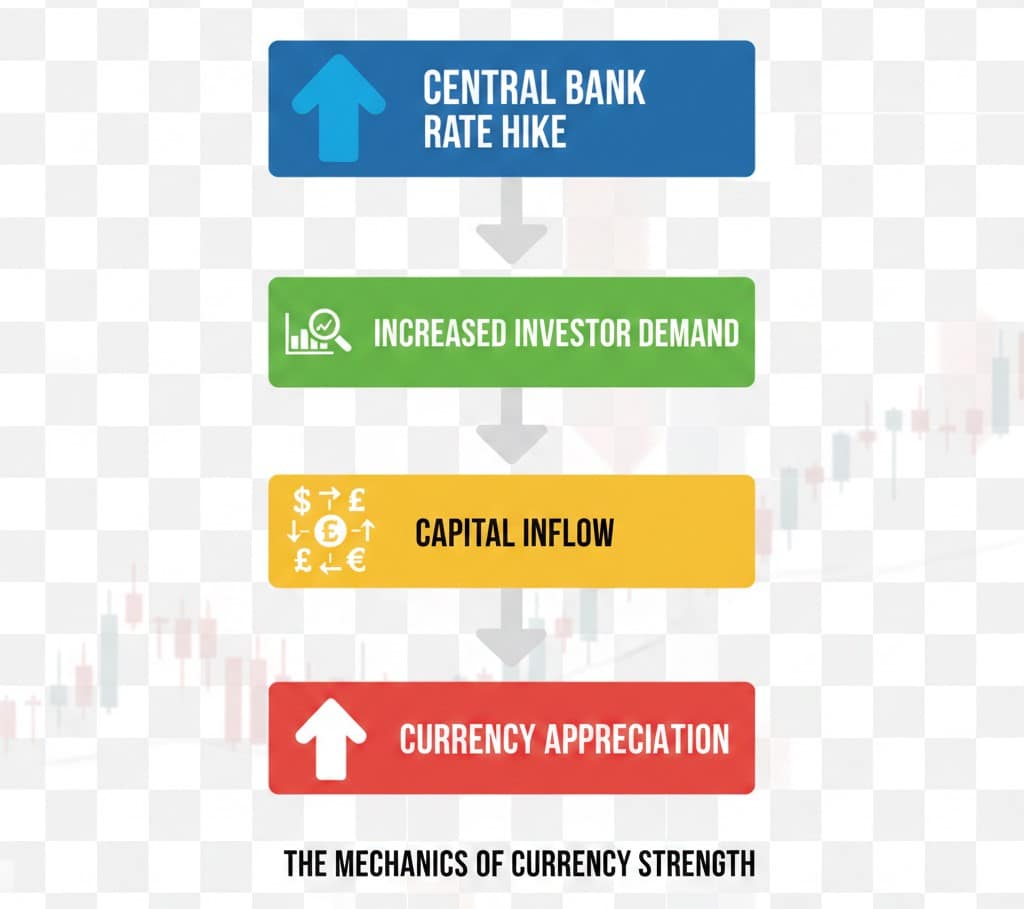
At its core, an interest rate is the reward for holding a specific currency. When a central bank like the Federal Reserve raises rates, it increases the return on dollar-denominated assets like Treasury bonds. Global investors move their capital to where the yield is highest, creating massive demand for that currency.
Conversely, high inflation erodes purchasing power. If a bank doesn’t raise rates fast enough to keep up with rising prices, the currency often weakens despite the “high” nominal rate. This balance is known as the monetary policy tightrope.
Federal Reserve vs. Bank of England: A Tale of Two Tapers (2026 Case Study)
As of February 2026, we are witnessing a fascinating convergence. The Federal Reserve has held the federal funds rate steady in the 3.50% to 3.75% range after a series of aggressive cuts in 2025. Meanwhile, the Bank of England (BoE) recently voted 5-4 to maintain their Bank Rate at 3.75%.
| Central Bank | Current Rate (Feb 2026) | Recent Action | Sentiment |
| Federal Reserve (USD) | 3.50% – 3.75% | Hold (Jan 2026) | Neutral / Wait-and-See |
| Bank of England (GBP) | 3.75% | Hold (Feb 2026) | Cautiously Dovish |
This narrow gap or “yield differential” is why the GBPUSD (the Cable) has been trading in such a tight range. Traders are currently waiting for a “decoupling” event where one bank cuts while the other holds.
How Interest Rates Drive the GBPUSD “Cable” Exchange Rate
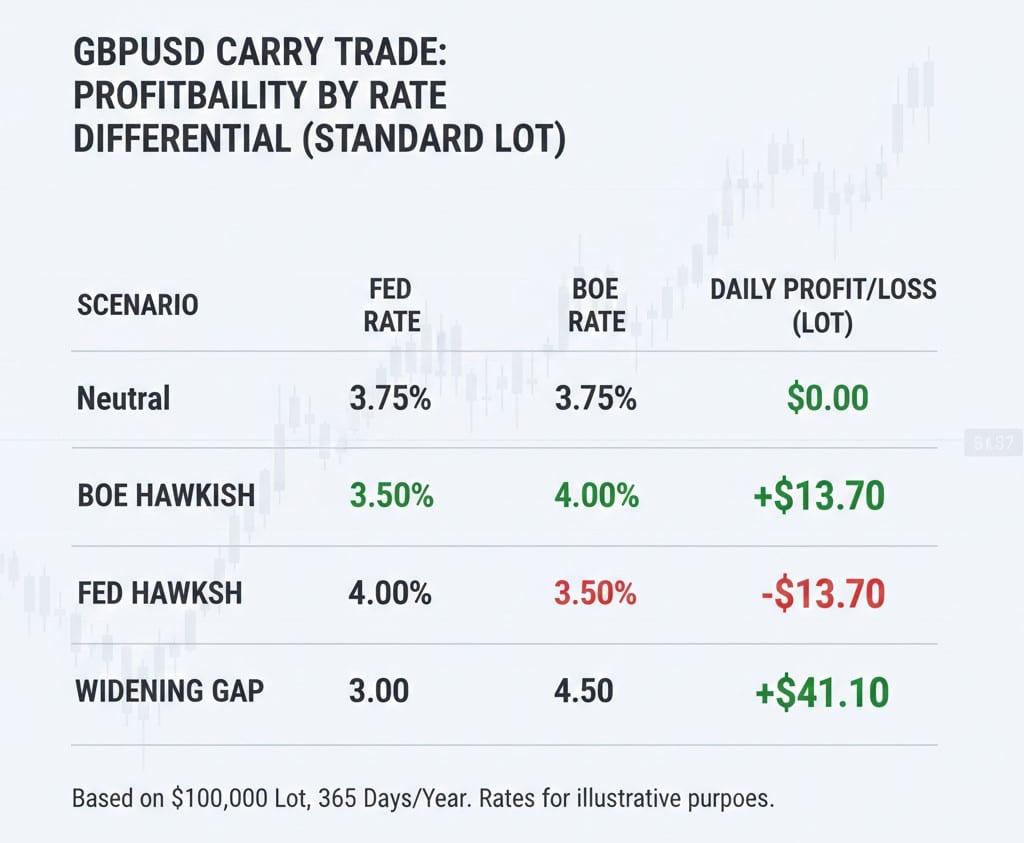
In Forex, you aren’t just trading a currency; you are trading a ratio. When you buy GBPUSD, you are betting that the UK’s monetary policy will remain more “restrictive” (higher rates) than the US.
This is known as the Carry Trade. Large institutions borrow money in currencies with low interest rates to invest in those with higher yields. Even a shift of 25 basis points (bps) can trigger billions of dollars in move orders.
Recent Case Examples: The February 2026 Pivot Points
Early February 2026 provided a textbook example of market sensitivity. UK CPI inflation data showed a drop to 3.4%, which was lower than the BoE’s projections.
Initially, the Pound dropped as traders anticipated a rate cut. However, when Andrew Bailey and the MPC opted for a “Hawkish Hold” at 3.75%, the GBPUSD saw an immediate recovery. This proves that market expectations often matter more than the data itself.
Key takeaway for traders at https://sarowarjahan.com: Always compare the actual news against the “priced-in” consensus.
FAQ: Interest Rates and Forex Trading
Why do higher interest rates strengthen a currency?
Higher rates offer increased returns for lenders and investors, attracting foreign capital. This creates higher demand for the currency. As investors buy the currency to access high-yielding assets, its value rises against lower-interest counterparts.
How does a Bank of England rate cut affect the GBP?
A rate cut makes UK assets less attractive, typically leading to capital outflow and a depreciation of the Pound. If the Fed maintains higher rates while the BoE cuts, the GBPUSD will likely face significant downward pressure.
What is the relationship between inflation and interest rates?
Central banks use interest rates to control inflation; high inflation triggers hikes to cool the economy. Conversely, when inflation falls toward the 2% target, banks often cut rates to prevent economic stagnation.
What are “Basis Points” (bps) in interest rate news?
One basis point is equal to 0.01%, the standard unit for measuring interest rate changes. Most central bank moves occur in 25 bps or 50 bps increments. These shifts directly impact the “Swap” rates you pay on your trading account.
Connect on Telegram Don’t miss out on critical market updates. Join my Telegram community for the latest news and trading signals delivered straight to your phone: https://t.me/mql5signals_Sarowar