


You’ve seen it happen. The Federal Reserve announces a rate hike, and the EUR/USD chart plunges 50 pips in seconds.
For many traders, these moments are confusing. You see “positive” news, yet the market moves against you. You try to trade the breakout, but slippage eats your profits.
Volatility is the lifeblood of Forex, and interest rates are the heartbeat.
If you don’t understand how central banks manipulate these rates, you are trading blind. But if you master this relationship, you unlock the ability to predict long-term trends and short-term spikes.
Here is the professional breakdown of why interest rates rule the market, and how you can position yourself on the right side of the trade.
The Mechanics: How Interest Rates Drive Currency Value
At its core, Forex trading is about capital flow. Money goes where it is treated best.
Interest rates dictate the return on investment (ROI) for holding a specific currency. When a central bank raises its interest rate, that currency essentially pays a higher “yield” to investors.
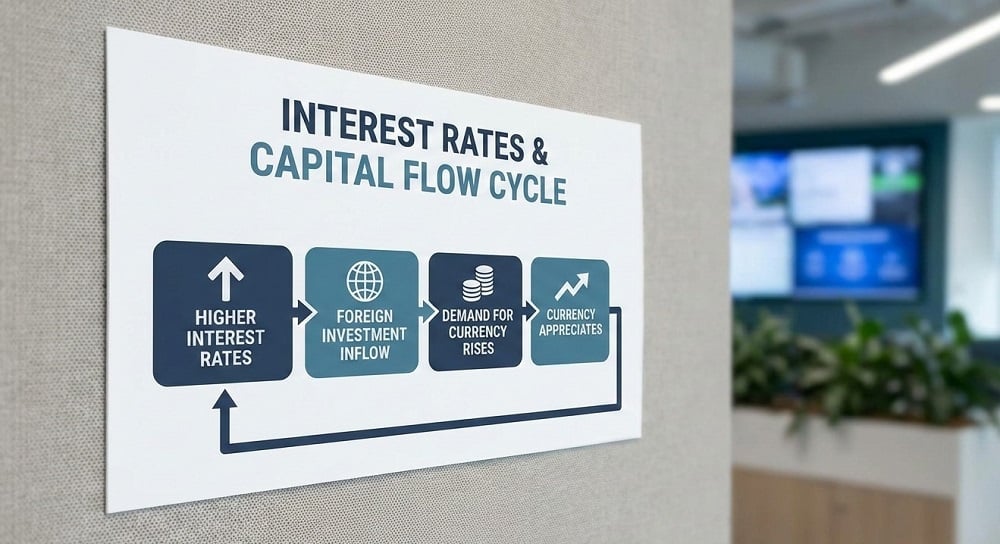
The Logic Chain:
- Higher Rates: The Central Bank raises the benchmark rate.
- Higher Yields: Government bonds and savings in that currency offer better returns.
- Capital Inflow: Foreign investors sell other currencies to buy this one.
- Appreciation: Increased demand drives the currency value up.
Conversely, when rates are cut, investors pull their money out to find better returns elsewhere, causing the currency to depreciate.
Hawks vs. Doves: Decoding Central Bank Language
You don’t always need to wait for the official number to be released. Central bankers tell you what they plan to do weeks in advance. You just need to speak their language.
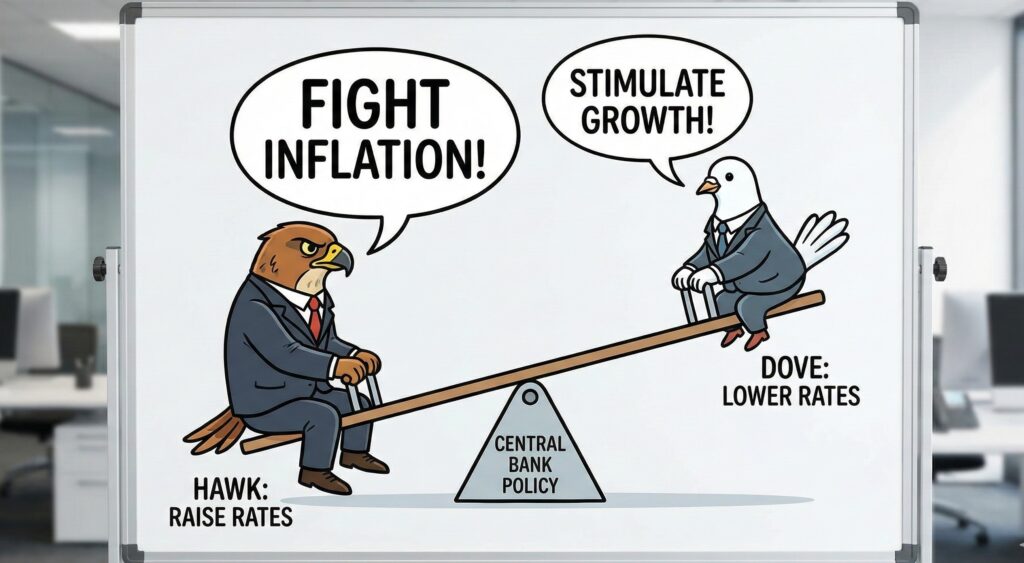
Traders classify central bank statements into two categories: Hawkish and Dovish.
| Feature | Hawkish (The Hawk) | Dovish (The Dove) |
| Primary Goal | Fight Inflation | Stimulate Economic Growth |
| Action | Raise Interest Rates | Lower Interest Rates |
| Tone | Aggressive, warning about prices | Cautious, worried about jobs/GDP |
| Currency Impact | Bullish (Currency Strengthens) | Bearish (Currency Weakens) |
| Example | “We will do whatever it takes to lower CPI.” | “We need to support the labor market.” |
Pro Tip: If the Fed Chair sounds “Hawkish” during a press conference, the USD will often rally immediately, even if they didn’t change the rate that day.
The Strategy: How to Trade Interest Rate Differentials
Professional traders don’t just guess; they look for the Carry Trade.
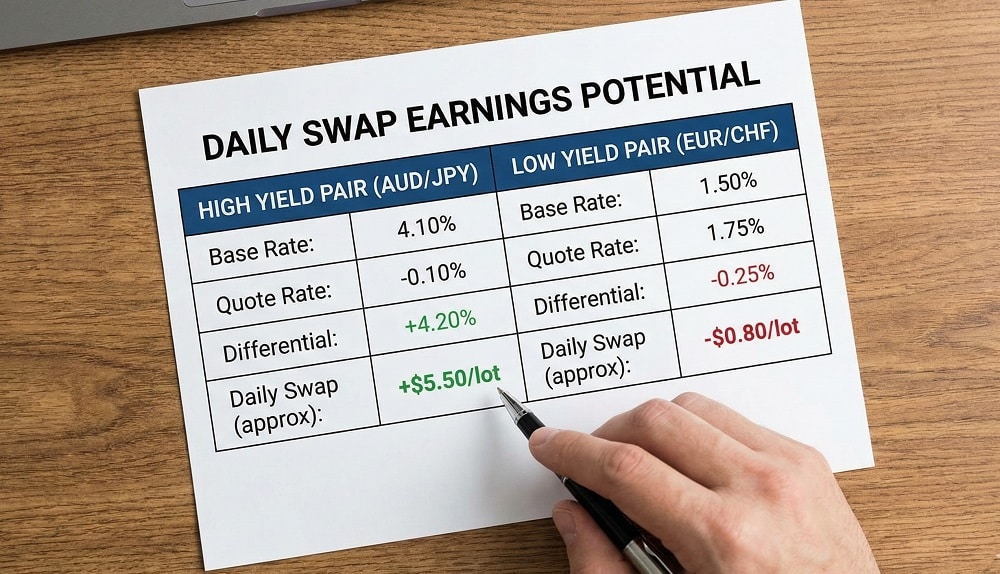
This strategy involves buying a currency with a high interest rate against one with a low interest rate. You aren’t just betting on the price moving up. You are actually earning interest (the Swap) every single day you hold the position.
Example Scenario:
- Buy: AUD (Interest Rate: 4.10%)
- Sell: JPY (Interest Rate: -0.10%)
- Result: You earn the difference (the differential) daily.
As long as the high-rate currency remains stable or strengthens, you profit from both the price movement and the daily interest payments.
When the Rules Fail: “Buy the Rumor, Sell the Fact”
This is where beginners get trapped.
Sometimes, a central bank will raise rates—exactly as predicted—and the currency will crash. Why?
Because the market is a discounting mechanism.
Big institutions and funds price in these events weeks in advance (“Buy the Rumor”). By the time the actual announcement happens (“The Fact”), the buyers have already bought. They use the liquidity of the news release to sell their positions and take profit.
The Lesson: Never trade the headline alone. Compare the actual data to the market consensus. A 0.25% hike is meaningless if the market was expecting 0.50%.
The Risk: Why Manual Trading Fails During News
Trading interest rate decisions offers high rewards, but the risk is extreme.
During a Rate Statement or FOMC Press Conference:
- Spreads widen: The cost to enter a trade can triple.
- Slippage occurs: You get filled at a price much worse than you clicked.
- Whipsaws: Price spikes up and down instantly, hitting stop-losses on both sides.
Most retail traders lack the infrastructure to handle this speed. This is why many professionals shift to Fund Management or Automated Signal Copying.
The Professional Solution
Instead of fighting the volatility manually, consider leveraging verified expertise. At Sarowar Jahan, we focus on disciplined risk management that accounts for these macroeconomic shifts.
Whether you are looking for professional Fund Management or verified Signal Copying (via MQL5 or SignalStart), our systems are built to weather high-impact news events without the emotional errors of manual trading.
Don’t let a Fed announcement wipe out your account. Check our verified track record to see how professional management handles market volatility.
Frequently Asked Questions (FAQ)
Q: How do interest rates affect forex trading?
Interest rates are the primary driver of currency trends.
Generally, higher rates attract foreign capital, increasing demand and causing the currency to appreciate. Conversely, lower rates reduce demand, causing the currency to depreciate.
Q: What is an interest rate differential?
It is the difference in interest rates between two currencies.
This differential is the foundation of the Carry Trade. Traders buy high-rate currencies against low-rate currencies to earn the daily interest difference (swap).
Q: Does raising interest rates always strengthen a currency?
No, not always.
While it usually does, if a rate hike signals that the economy is in trouble (e.g., stopping runaway inflation or recession risk), investors may fear instability and sell the currency, causing it to weaken.
Q: How do I trade the news during interest rate decisions?
Use caution and watch for the “Surprise Factor.”
Compare the actual data to the forecast. The biggest moves happen when the central bank does something the market did not expect. However, due to volatility, using professional signals or reduced leverage is recommended.
Q: Which central banks have the most influence on Forex?
The “Big Four” control the major moves.
These are the Federal Reserve (USD), the European Central Bank (EUR), the Bank of England (GBP), and the Bank of Japan (JPY). Their decisions impact over 80% of global daily trading volume.
Connect on Telegram Don’t miss out on critical market updates. Join my Telegram community for the latest news and trading signals delivered straight to your phone: https://t.me/mql5signals_Sarowar